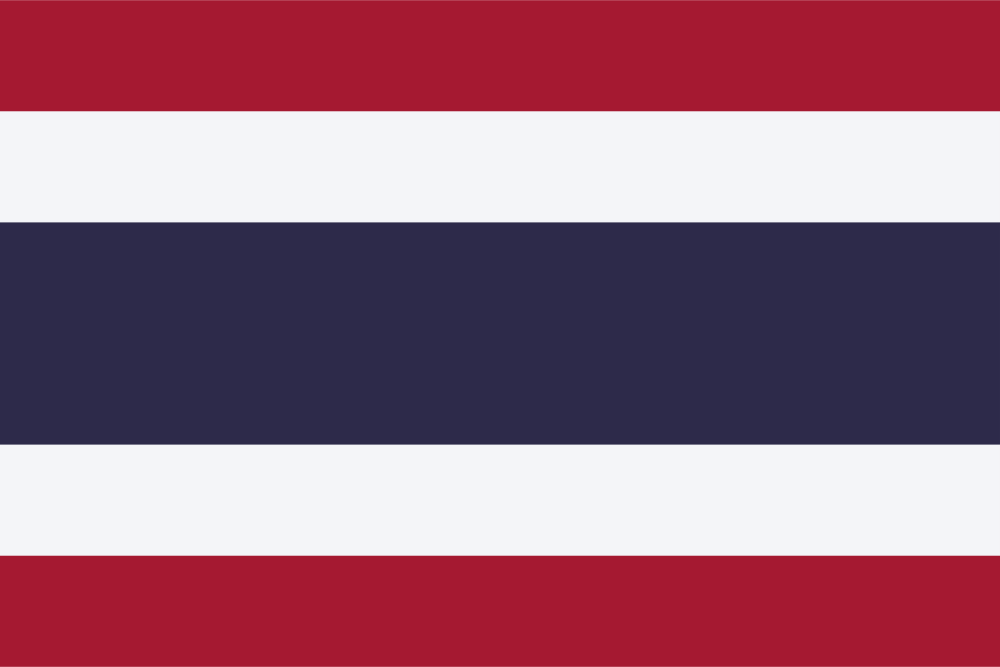
Thailand🕣
Country in Southeast Asia. Official name – the Kingdom of Thailand. Population - 70.1 million (as of 2020). Capital – Bangkok. Official language – Thai. Government type – constitutional monarchy. Main religion – Buddhism.
Thailand
Greeting
When meeting with representatives of foreign companies and organizations, Thai entrepreneurs and officials usually greet with a handshake. However, this is not the traditional form of greeting in Thailand.
The traditional Thai greeting is the wai. When two people of equal social or professional status meet, they greet each other by placing their palms together at chest level—fingers pointing upward, thumbs touching the chest. A slight bow accompanies this gesture.
If there is a difference in status between the individuals, the wai greeting changes slightly: the person of lower status raises their pressed palms higher so that the fingertips touch the lips. An even higher wai is used to greet a highly respected, distinguished, or older person—here, the thumbs are pressed to the tip of the nose. In all versions of the wai, the elbows should remain close to the body.
Regardless of the greeting ritual, it is always accompanied by the verbal "Sawatdee!" (Hello! Hi!). When addressing a woman, the polite particle "kha" is added, making the greeting "Sawatdee kha." For men, the particle "khrap" is used, resulting in "Sawatdee khrap." This phrase is also used for saying goodbye.
If a woman is present at a meeting, a man should wait for her to initiate the handshake.
During events involving people of different genders, ages, or social and professional statuses, it is customary to introduce the man to the woman, and the younger person to the older one.
Introduction
Surnames did not always exist in Thailand—they were only introduced in the 1920s. This was formalized by a legislative act, after which the king "granted" surnames to the most influential Thai families. According to the law, every Thai citizen must have a first name and a surname (without middle names, patronymics, or any additional name elements).
Thai surnames are often long and quite difficult to pronounce, even for Thais themselves. As a result, people typically use only their first names in conversation, reserving their surnames for official or formal situations and written correspondence.
Hierarchical relationships and social status are very important. This is especially evident in how people address each other. Forms of address reflect a person’s titles, such as academic degrees, professional qualifications, or job positions. One common respectful title is "Khun," which is gender-neutral. For example, a man named Kittichat Wattapongsiri would be addressed as Khun Kittichat, and his sister, Mekhala would be addressed as Khun Mekhala.
In English, Khun corresponds to polite forms such as Mr., Mrs., Ms., or Miss.
During conversation, your Thai colleague may address you by your first name with the polite form Khun, for example, Khun Andrew. The same can be in English: Mr. Andrew. Don’t see this as over-familiarity—Thais use communication patterns of their culture when interacting with foreign partners.
In addition to given names, Thais often have nicknames, which are given in early childhood. Even if you know your colleague’s nickname, it’s best not to use it unless they invite you to do so.
After marriage, Thai women usually take their husband’s surname, and children typically inherit their father’s surname.
Exchange of Business Cards
Exchanging business cards is quite common—not only during meetings and negotiations, but also at various social, economic, and political events. You should always carry an ample supply of business cards with you.
It is advisable to have one side of your business card in Thai. Ideally, the translation should be done by a local professional to ensure accuracy and appropriateness.
In addition to your name, surname, and contact information, include your position, professional qualifications, academic degrees or titles, and any additional competencies. These details are highly valued by Thai colleagues.
There is no strict ritual for exchanging business cards in Thailand, but you should hand your card over with your right hand, starting with the most senior person present.
When receiving a business card, hold it briefly with both hands, take a moment to read it carefully, and then place it on the table in front of you or into a business card holder—not in your pocket or wallet.
Treat the business card with respect. Do not make notes on it, write anything, or bend it.
Small Talk: Overview
In Thai business culture, building and maintaining good relationships is super important—especially when dealing with international partners. That’s why it’s a good idea to put some extra effort into small talk with Thai colleagues.
When you’re chatting with a Thai partner, try to keep the conversation calm, friendly, and informal. Avoid being too blunt or direct, since that could make the other person feel embarrassed or uncomfortable.
Small talk is usually about general topics. It’s best to keep things polite and neutral, using softer, more indirect language instead of saying things too straightforwardly.
Silence is an important part of conversations. People might pause quietly to show they’re listening carefully and respecting the speaker. It’s like they’re taking a moment to reflect on what was just said. If the pause feels long, don’t worry—it’s normal. Just be patient.
Unlike in some cultures, staying quiet for some time during a conversation isn’t seen as awkward in Thailand, whether it’s in a business setting or not. Someone who talks a lot might come across as a bit immature or inexperienced. So don’t feel like you have to respond to every single thing the other person says.
People in Thailand often communicate indirectly, especially when things get a little tense. They might use metaphors, comparisons, or descriptive language to get their point across. The key is to be really tactful and pay close attention to what your partner is saying.
Preferred Topics
Classic questions like “How was your flight?”, “What’s the weather like this time of year?”, or “Which hotel are you staying at?” are good for starting a conversation.
A good way to keep the conversation going is to talk about the space you’re in—like your Thai colleague’s office—or comment on things around you, like photos or artwork on the walls.
Your Thai colleague will likely find it easy to talk about work, especially the nature of their job, what makes it unique, or how it compares across different countries.
It’s always a good idea to share positive impressions of the country and mention some of the places you’ve visited in Thailand. That kind of personal touch is very well received.
Taboo Topics
It’s best to avoid talking about politics, especially any internal conflicts from the past decade.
Don’t bring up the situation with separatists in southern Thailand, and don’t share any opinions or judgments about it.
Never make any critical remarks about the Thai royal family, especially the King, Queen, or their children. Thai people deeply respect both current and past monarchs. King Bhumibol Adulyadej (Rama IX), in particular, is especially beloved.
He reigned for over 70 years (from 1946 to 2016), making him not only Thailand’s longest-serving king but also one of the longest-reigning monarchs in the world. His deep connection with the Thai people came from his genuine efforts to improve their lives—he initiated thousands of development projects in agriculture, water management, education, and healthcare, especially in rural areas.
The musical “The King and I” (about the English teacher Anna Leonowens who came to Siam in the 1860s to teach the royal family) is considered offensive by many Thais.
Topics like salary, income, and standard of living are seen as very personal and are best avoided.
Personal Space
When talking, people in Thailand—men and women alike—usually stand about an arm’s length apart.
In general, physical contact isn’t really welcomed, apart from a handshake. That means no hugging, cheek-kissing, or friendly pats on the back or arm—those can feel too personal or inappropriate.
Thais also avoid too much gesturing or speaking loudly. Over-the-top gestures or raised voices can come off as rude or disrespectful.
Be mindful of your hands during conversations—don’t wave them around too much, and try not to keep them in your pockets.
Self-control is highly valued, especially in emotional situations. Public displays of strong feelings—especially negative ones like anger or frustration—can cause someone to “lose face,” and that can affect everyone present.
Thailand is often called “the Land of Smiles,” and for good reason—Thais smile a lot! But those smiles can mean different things: a greeting, thanks, an apology, even just polite curiosity.
Communication Specifics
Thai society is considered high-context, meaning not everything is said out loud. A lot of information is understood from the situation itself or shared cultural understanding.
Nonverbal cues often carry more meaning than spoken words. Thais believe that words can sometimes distort or hide the true message, sometimes even on purpose, whereas body language tends to be more honest.
If something’s unclear or seems confusing, it’s okay to gently ask your Thai colleague to clarify.
The concept of “face” is very important. It refers to a person’s image, reputation, and the way others see them. Publicly criticizing, contradicting, or embarrassing someone can cause them to “lose face”—and that should be avoided.
Thais are very careful to protect their own face and avoid making others lose face too. If they need to say something negative or difficult, they’ll usually do it in a very polite, indirect way—talking around the issue rather than addressing it head-on.
When dealing with tricky topics, try to approach things gently and maybe bring it up again later in a different way.
Any questions? Contact us.
Ask a Question