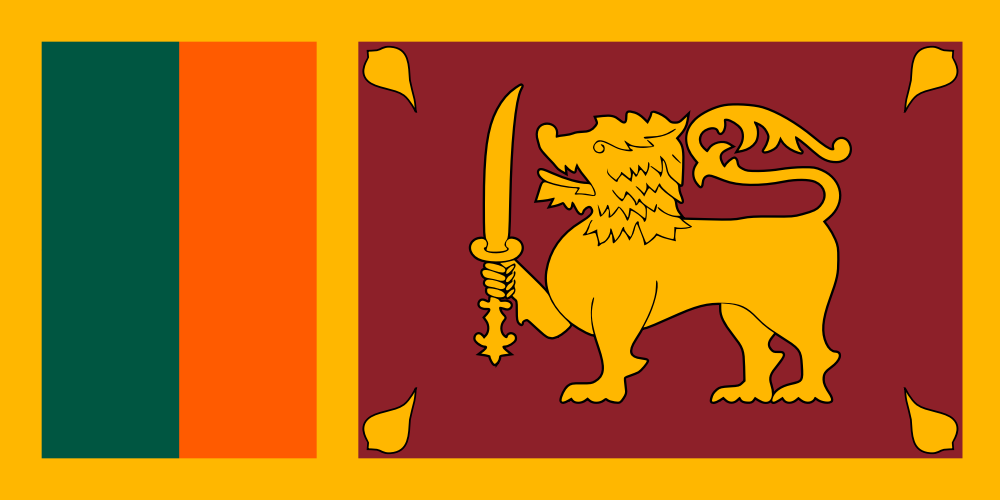
Sri Lanka🕣
Country in the southern part of Asia. Official name – the Democratic Socialist Republic of Sri Lanka. Population – 21.5 million (as of 2020). Capital – Colombo. Official languages – Sinhala and Tamil. Government type - unitary semi-presidential republic. Main religion – Buddhism.
Sri Lanka
Greeting
In business practice, handshakes are common and should not be too weak or soft; on the contrary, they should be fairly firm. This greeting ritual is also followed by young people in casual communication.
Older generations greet each other according to traditional customs, which vary slightly across different ethnic groups.
The population of Sri Lanka is highly diverse. It includes Sinhalese (the largest ethnic group, about 75%), Tamils (the second largest, around 11%), as well as Sri Lankan Moors, Burghers, and Veddas.
A traditional greeting ritual in these cultures is a gesture similar to the Indian Namaste, in which the palms are placed together at chest level with a slight bow. Differences in this ritual lie in the accompanying verbal expressions exchanged by speakers—for example, Ayubowan is the Sinhalese greeting and Vannakkam is the Tamil one. Both phrases carry the same meaning: "May the Lord grant you a long life."
Men generally shake hands with men, and women with women. Handshakes between men and women are very rare due to religious differences.
If your Sri Lankan partner is accompanied by a group, greet the eldest or highest-ranking person first.
Warmer greetings, such as hugs or kisses, are only appropriate between relatives or people who have known each other well for a long time.
Wait for your partner to suggest addressing them by their first name.
Introduction
The ethnic groups living in Sri Lanka have different naming traditions. For example, in Sinhalese culture, a person is given three names at birth: the first is the paternal family name, the second is the personal name, and the third is the surname. For instance: Nandasena Gotabaya Rajapaksa.
Sinhalese women adopt their husband’s surname after marriage while retaining their paternal family name.
When migrating to other countries, especially in Europe or Australia, many Sinhalese drop the family name and keep only the personal name and surname, in line with local naming conventions.
In Tamil culture, surnames are not traditionally used. Instead, a person often uses their father’s name, placing it before their own. After marriage, women replace their father's name with their husband’s, which functions as a surname in this context.
Status is highly important in Sri Lanka and is based on such factors as age, university education, caste affiliation, and profession.
Honorific, professional, and academic titles are commonly used with either the name or surname. Titles such as “Doctor,” “Professor,” and “Engineer” are held in especially high regard.
In the absence of professional or academic titles, use polite forms of address such as Sir or Madam (without using a name), or Mr, Mrs, or Ms (used with the person’s surname or name).
Exchange of Business Cards
Exchanging business cards usually takes place after greeting your partners.
Academic degrees, titles, and professional qualifications (if any) should be indicated on the business card.
It would be good to have business cards in Sinhala or Tamil. However, this is not mandatory, as English is the language used for business purposes inside the country.
Any materials (including business cards) should be handed to your partner with your right hand or both hands; when receiving materials, also use your right hand.
In Sri Lanka, business cards are treated with respect. After receiving a card during a greeting, do not write on it, make notes, bend it, or put it in your pocket.
Small Talk: Overview
First meetings between potential partners in this culture are viewed as an opportunity to get acquainted and build relationships. Small talk, in this context, is an important part of the negotiation process, as your Sri Lankan partners want to know who they are dealing with.
Engage in this conversation. You may be asked not only — and not so much — about your business, but also about yourself, your life, and your family. Some questions might seem too personal or unrelated to business. Be prepared for a patient conversation and understand that your sincere answers will help establish long-term business relationships.
A soft, delicate, polite, and modest manner of communication will be well received.
Pay attention to how emotionally your speech comes across. Avoid raising your voice and control the expression of emotions, especially negative ones such as anger, frustration, or irritation. In this culture, such behavior is perceived as a loss of self-control.
Despite the availability of modern means of communication, face-to-face contact is valued above all.
Preferred Topics
Family is an important aspect of life for Sri Lankans, so this topic often comes up in conversation.
Among the questions you may be asked are: “Are you married?”, “Where did you study?”, “When did you graduate from university?”, “Where else have you worked?”
There is also great interest in the regions or countries represented by the people they are speaking with. A wide range of topics may be discussed, including local cuisine, traditions, holidays, events, and more.
Cricket is an excellent topic for conversation, as it is very popular. Many Sri Lankans play the game themselves or enjoy watching others play.
Taboo Topics
Politics is a sensitive and complex topic for discussion. Any mention of the Civil War, which lasted from 1983 to 2009, may be especially painful. One of the parties involved in the conflict was the terrorist organization Tamil Tigers, known for their particularly aggressive actions.
Avoid drawing parallels or making comparisons between Sri Lanka and India — this may come across as offensive to your Sri Lankan colleague. The people of Sri Lanka take great pride in their own ancient history and culture.
Religion and everything related to it are highly sensitive topics and must be avoided. Sri Lanka is home to people of various religious beliefs: Hindus, Muslims, and Catholic Christians, with the vast majority (over 75%) being Theravāda Buddhists.
Never speak (or even joke) on topics related to sexual relationships.
Personal Space
The comfortable distance for communication is approximately an arm’s length. Sri Lankans traditionally respect each other’s personal space during conversation.
Physical contact during communication is kept to a minimum, especially in interactions between men and women.
During conversation, people of equal status and position maintain direct eye contact. However, eye contact is minimal between individuals of opposite sexes.
When people gently tilt their head from side to side (not turning, but leaning alternately to the right and left), this is often misunderstood by people from other cultures as meaning “no.” In reality, this gesture has multiple meanings, ranging from a silent “yes” or “thank you” to simply showing that the speaker is being listened to (though not necessarily agreed with).
Communication Specifics
In Sri Lankan culture, personal relationships are very important. Introductions through third-party recommendations are common. In this country, people prefer to do business primarily with those they trust.
Trust is often built on family ties or shared experiences, such as studying or working together. Nepotism (favoring relatives or friends regardless of their professional qualifications) is present across all areas of society.
Respect for elders is of value in this culture. In conversation, older people should be addressed first, and their opinions should be carefully considered.
During communication, your Sri Lankan partners may avoid discussing sensitive or problematic issues, even if they are important. They tend to prefer gentle and indirect expressions over critical remarks that might lead to a loss of face.
If you truly need to understand your Sri Lankan colleague’s attitude toward a particular topic, avoid asking direct, yes-or-no questions—especially those that may require a negative answer. Instead, opt for open-ended questions that allow for a range of responses.
Any questions? Contact us.
Ask a Question