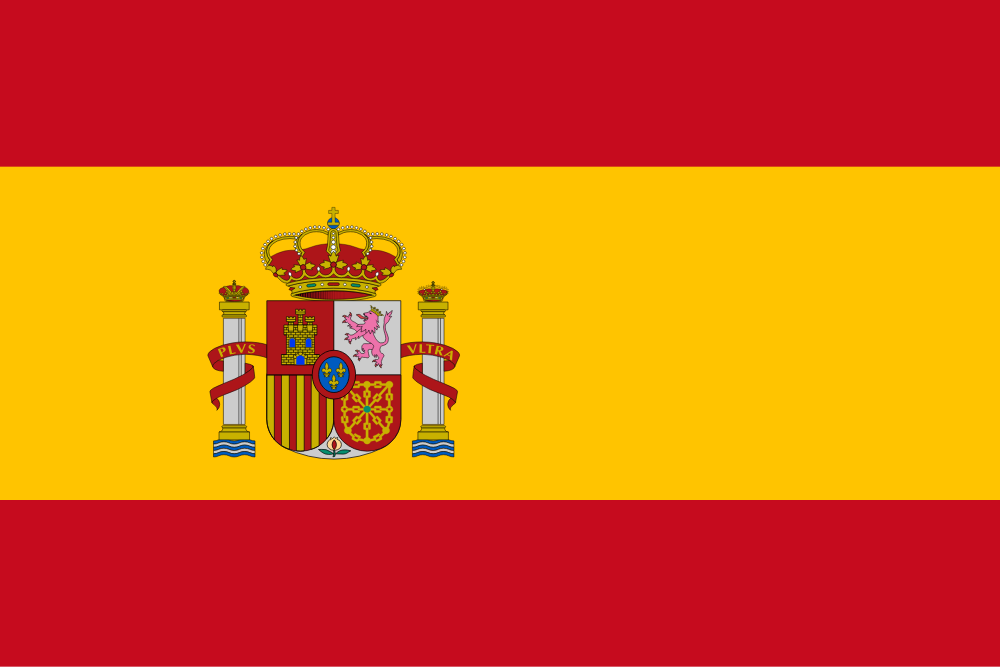
Spain🕣
State in southwest Europe. Official name – the Kingdom of Spain. Population – 46.7 million (as of April 2021). Capital – Madrid. Official language -Spanish (Castilian). Government type – parliamentary constitutional monarchy. Main religion – Catholicism.
Spain
Greeting
While being introduced, the parties exchange a handshake, which should be quite strong, but at the same time short. It is important to maintain eye contact with your partner.
Spaniards shake hands before and at the end of a meeting. This is a customary greeting ritual not only in formal but also in informal situations even if they have known each other for a long time.
Between close friends, hugs and kisses (on each cheek, starting from the left) are accepted. There is no real kissing involved. The interlocutors just lightly touch each other's cheek.
Kissing is more common as a greeting between women, although it is also possible between women and men who, for example, are long-time partners or have worked together in the same company for many years.
As you get to know your Spanish partner better, the relationship may become closer. In this case, greetings between men may include a hug and a pat on the shoulder or upper arm in addition to a handshake. However, wait for your Spanish counterpart to take the initiative and determine your willingness to switch to warmer forms of greeting, as they are not appropriate in all situations.
Common forms of greeting are: "Buenos dias!" (Good morning! or Good afternoon!) is used in the morning; "Buenas tardes!" (Good evening!) is used in the afternoon (approx. from 3 pm to 9 pm); "Buenas noches!" (Good night!) is used late, starting at 9 pm.
The greeting is often accompanied by the question "¿Como está?" (How are you?).
A less formal greeting is "Hola!" (Hello!)
Introduction
One can say, that Spaniards have two surnames, for example, Mario López Covas, which a child receives at birth from his or her parents. The first is the father's first surname and the second is the mother's first surname. In the example above, Mario is the child's first name, López is his first surname, which he received from his father, whose name was Juan López Marcos, and his second surname is Covas, which he received from his mother, named María Covas Callas.
When addressing a person, it is customary to use their first surname, which they received from their father.
However, in business correspondence, it is appropriate to use both surnames. That’s because there are several common surnames in Spain, which can lead to some misunderstandings if only one surname is used. By using both surnames, however, you can be sure that your letter will be received by the intended recipient. In official documents and, for example, correspondence with various organizations, two surnames are always used.
Spaniards can also have two names, for example, Miguel Marίa Villacorta Hernández, and the second name does not necessarily correspond to the gender of the bearer. The first name can be used separately without mentioning the second name.
In formal communication, as well as in initial contact, use the partner's professional titles or ranks, if available. For example, university professors may use the academic degree "Profesor/Profesora", and engineers may be addressed as "Ingeniero/Ingeniera".
If, however, you do not know the professional title or rank of your partner (or it simply does not exist), use polite forms of address, namely: 'Señor' (or Mr - Sir) for men and 'Señora' (or Ms - Madam) for women.
When addressing a woman, foreigners should avoid using the polite form Señorita, as many young women may find it offensive.
When using names and titles/ranks, follow the example of your Spanish colleagues. Stick to the appropriate level of formality.
Spaniards quickly start addressing each other by their first name, including in professional contacts. To show respect, they use the polite forms Don (before the man's name) or Doña (before the woman's name). However, in this case, you should be very careful and follow the lead of other Spanish colleagues.
Spanish women do not usually change their surname to that of their husbands after marriage.
Exchange of Business Cards
In Spanish business practice, it is customary to exchange business cards during introductions as part of the first meeting.
The text of the business card, at least on one of its sides, must be in Spanish.
There is no special ritual when handing over a business card in Spanish business practice.
Small Talk: Overview
Spaniards are attuned to building a personal relationship with their partner and therefore attach great importance to conversing with them. They usually enjoy small talking.
Small talk with a Spanish colleague can take some (sometimes quite long) time. There will be room for jokes and humor, as well as questions about family or personal hobbies.
Communicating after lunch/dinner at a restaurant is common. This may lead to a closer relationship, which is very important for Spanish partners.
Keep in mind that this kind of socializing can last quite a long time and end late at night. If for some reason you are not ready for this, simply thank your Spanish partner for a wonderful evening and say goodnight. Spaniards are generally aware that not everyone is prepared to share their late socializing traditions.
Preferred Topics
Your country or place you are from usually interests people.
Your positive perception of Spain: the places you visited and liked.
Ask what region/city your partner is from. Share your (positive) impressions of the place if you know it. If not, ask a couple of questions, thus showing interest and respect for your partner at the same time.
Travelling, hobbies, hobbies.
Sports and, in particular, football. Do not criticize a particular (maybe someone's favorite) football team.
Art, especially if you are familiar with Spanish art and literature.
Taboo Topics
All religious topics are taboo.
Avoid criticizing the culture, the people, the authorities, or some rules and procedures in Spain. Even if Spaniards themselves openly complain about local politicians, it does not mean that foreigners are "allowed" to do the same. No matter what, Spaniards are very proud of their country and their cultural heritage.
Do not bring up topics related to regional nationalism and, in particular, the independence movement in Catalonia, even if you know your partner's background (and know that he or she is from the region) and you know his or her opinion. If the topic, for whatever reason, comes up in conversation, try to refrain from expressing your opinion, rather ask questions and keep the conversation as neutral as possible.
Avoid mentioning the name of Francisco Franco and the time of his rule, as well as the Spanish Civil War of 1936-1939. This topic still evokes various associations in Spanish society, including painful ones.
Do not make jokes or any unflattering remarks about the Catholic Church or the Pope, especially in the company of older Spaniards. The younger generation may be more accepting of such humor, but it is still best not to take any risks.
Personal Space
When talking, Spaniards often stand quite close to each other (the distance can be up to half a meter). They gesture actively and may touch each other, for example by patting each other on the shoulder or arm.
You should not copy the behavior of Spaniards in conversation. Body language is, in general, a rather complex area, which is well understood only by native speakers.
Communication Specifics
In the early stages of a business relationship, Spanish partners may behave in a rather formal way, sticking to protocol, and forms of address.
This kind of respect is shown to new business partners or to individuals who hold high positions. Speech in this case should be appropriate to the situation.
Over time, the partners develop a closer relationship and a sense of trust, which is very important for Spaniards. The level of formality becomes lower, you can see it in communication in general and the speech forms used.
To interrupt your partner, or to ask an unexpected question during a speech - this is not considered rude in Spanish society. The same is expected of you, especially if you have something to say on the topic under discussion.
Any questions? Contact us.
Ask a Question