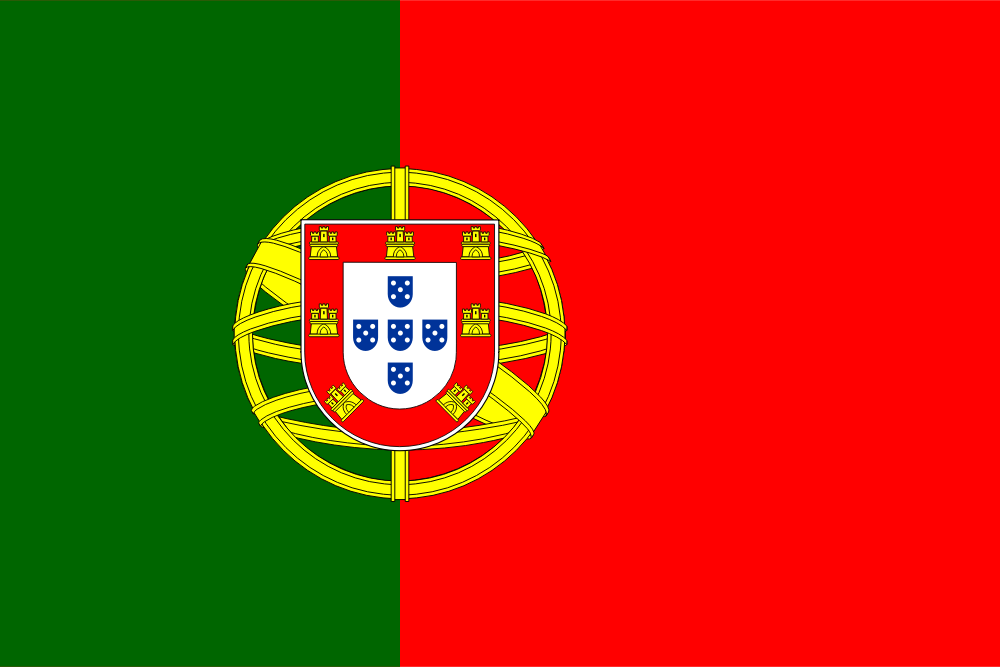
Portugal🕣
State in southwest Europe. Official name – Portuguese Republic. Population – 10.1 million (as of April 2021). Capital – Lisbon. Official language – Portuguese. Government type – parliamentary republic. Main religion – Catholicism.
Portugal
Greeting
During the greeting, the parties shake hands (not too firmly), maintaining eye contact.
Men who are close friends or relatives may, as part of the greeting, give each other a slight hug or pat on the back before shaking hands. Women in such situations exchange kisses (on each cheek, starting with the right cheek). As a rule, interlocutors just lightly touch each other's cheek.
When greeting a woman, men should wait until she extends her hand to greet him.
Coming to some event, greet everyone present. Handshakes are also exchanged at the end of the event when saying goodbye.
Common forms of greeting are: "Bom dia!" (Good morning! or Good afternoon!) is used in the morning; "Boa tarde!" (Good evening!) is used in the afternoon (approx. from 15.00 to 21.00); "Boa noite!" (Good night!) is used in the late evening, starting at 21.00.
A less formal greeting is "Ola!" (Hello!).
Introduction
The Portuguese have a rather complex naming system, which includes the mother's surname and the father's surname, as well as one or two first names. The mother's surname is given first and the father's surname last, e.g. Joana Filipa Santos Cunha.
During the introduction and later contacts, it is the father's surname that is used, it must be preceded by the polite form Senhor (or Mr.) when addressing a man (e.g. Senhor Morais) and Senhora (or Ms.) when addressing a woman (e.g. Senhora Cunha). In the latter case, an additional form of address, Dona, may be used, e.g. Senhora Dona Lopes.
Professional qualifications, academic degrees and titles, and job positions are important in Portugal. In this culture, status and hierarchy are respected. Be sure to mention your partner's insignia, especially if you are working with an engineer or architect, or you know for sure that your partner holds an academic degree.
When introducing someone, your Portuguese partner will first name the professional qualification / academic degree / job position and then the person's first and last name.
It may happen that your Portuguese partner does not mention his/her badge of honor when introducing himself/herself, but expects you to use it when addressing him/her. It is especially important to maintain this formal style when dealing with someone of higher status or rank.
If your partner has an academic degree, such as a master's degree, use the word doutor / doutora when addressing him. If he or she is a doctor of science, the accepted form of address is professor doutor / professora doutora, for example, Professora Doutora Isabel Santos.
If the professional title or rank of your partner is unknown to you (or simply does not exist), use polite forms of address, namely: Senhora (or Mr - Sir) for men and Senhora (or Ms - Madam) for women.
In terms of using names and titles/ranks, follow the example of your Portuguese colleagues. Stick to a level of formality appropriate to the situation.
In usual work settings, Portuguese tend to address each other by their insignia + first name (not surname). It is not uncommon to use the first of the two names a person received at birth. However, wait for your partner or colleague to take the initiative and suggest that you switch to this form of address.
Exchange of Business Cards
In Portuguese business practice, it is customary to exchange business cards, usually at the beginning or end of a business meeting.
It is advisable that the text of the business card, at least on one side of the card, is in Portuguese.
If you have an academic degree or professional qualification, write it on your business card. This will enhance your status in the eyes of the Portuguese partner.
Don't forget to indicate your job title on your business card as well.
There is no specific ritual for exchanging business cards in Portuguese business practice.
Small Talk: Overview
The communication style in general, especially at the early stages of a relationship, is rather formal. You can see it in the use of insignia - degrees, titles, professional qualifications, and job positions.
Although Portuguese society is traditionally hierarchical, young people are moving towards a more egalitarian style of communication, placing less importance on differences in status and position.
At public events, and in the early stages of business relationships, the Portuguese are rather reserved. Over time, however, your Portuguese colleagues will become more relaxed and emotional. They generally consider themselves less expressive than other Romance peoples, such as Italians and Spaniards.
Preferred Topics
Sport is one of the preferred topics of communication in Portugal. The only thing you should not rush into is mentioning your favorite team (e.g. in football) - it's worth clarifying first which team your Portuguese partner supports.
Travelling and tourism, especially trips to different regions of Portugal.
Portuguese culture, art, and history.
Portuguese cuisine, restaurants.
Family - yours and your interlocutor's. You may be asked quite a few questions about your family.
Taboo Topics
All religious topics are generally taboo. If the topic of religion comes up in conversation, be respectful, emphasizing the role of the Catholic Church and the Christian tradition in general in the development of the State.
Avoid criticizing or complaining about events, rules or actions of the authorities in Portugal.
Do not raise topics related to the situation of sexual minorities. In general, personal, including sexual relations, are taboo topics.
Refrain from speaking about politicians and avoid discussing political issues.
Personal finances or salaries should be avoided.
Do not compare Portugal and Spain. Although they are neighboring countries, there are quite a few differences between them. You should not expect a Portuguese person to know Spanish.
Personal Space
During the conversation, Portuguese people stand closer to each other when compared to some European (especially in central and northern European) cultures - the distance can be half a meter to a meter).
Physical touching and physical contact in general should be avoided in business meetings. However, outside the official context, the Portuguese are lively and emotional communicators, eager to express their feelings in different ways, including hugging and kissing.
When communicating with a Portuguese partner, especially during the first meetings, watch your posture, do not allow yourself careless and relaxed postures. This can be interpreted as disrespectful to the other person.
Communication Specifics
The style of communication in Portuguese society can vary from region to region: in the north, communication can be characterized as more pragmatic, direct, and less formal than in Lisbon and the south of the country.
Clear differences can also be seen in the business culture and communication between domestic and international companies. In the latter, hierarchical relationships and formality are less important, and more direct dialogue and openness in expressing opinions and stances are adopted.
In domestic companies and Portuguese society in general, people are more likely to avoid direct and categorical statements, especially if they may offend the other person in some way. Your Portuguese partner will try to soften bad news if he or she has to break it to you.
A Portuguese man's promises are not always motivated by a desire to fulfill them. It may be more important for him to maintain a good relationship or to show a gesture of goodwill as a response to his partner's expectations. Pay attention to hidden non-verbal signals and cues, and ask follow-up questions to be sure that the promise will be realized.
Portuguese people are attuned to building relationships, which needs time. Invest it in developing a relationship based on mutual trust and respect. Outward friendliness and hospitality in the early stages of developing contacts does not mean that your Portuguese partner is your friend.
Eloquence is valued in Portuguese society. It is important for people, especially those with a high position in society or even in a company, to demonstrate their knowledge and their level of education. A beautiful, colorful speech will certainly contribute to this while maintaining harmony in communication and, if necessary, being a way of saving face and avoiding difficult topics.
Concise, pragmatic communication is more likely to be perceived as cold and harsh.
Any questions? Contact us.
Ask a Question