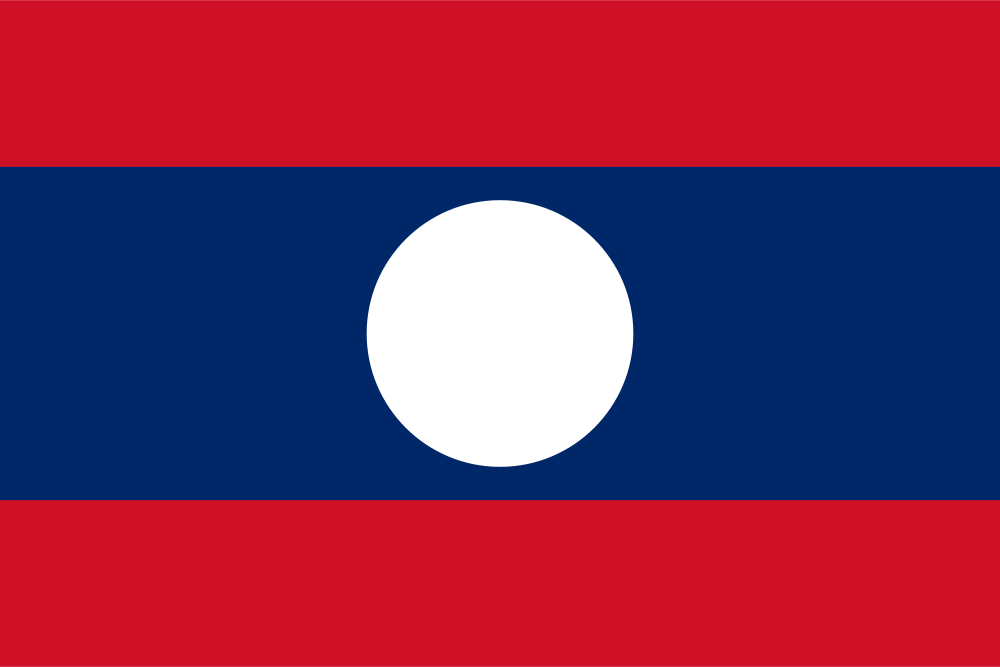
Laos🕣
State in Southeast Asia, in the center of the Indochina Peninsula. Official name – the Lao People's Democratic Republic. Population – 7.4 million people (as of 2020). Capital – Vientiane. Official language – Lao. Government type - people's democratic state with a presidential-parliamentary system. Main religion – Buddhism.
Laos
Greeting
In Laos' business practice, various forms of greeting can be observed. In meetings with representatives of foreign companies and organizations, it is customary to greet each other with a handshake. This ritual applies to all participants, regardless of gender.
The traditional Lao greeting is called **nop** or **wai**, and some experts refer to it as **nyok my wai**: palms are pressed together in a prayer-like gesture at the chest or head level, but not higher than the nose. This gesture is often accompanied by a slight bow toward the other person.
In addition to greeting, **nop** often carries additional meaning depending on the position of the hands and the depth of the bow. The higher the hands are raised and the deeper the bow, the greater the respect the person shows to their counterpart. Through **nop**, Laotians express feelings of appreciation and gratitude.
Businesswomen visiting the country should be aware that Lao male partners may not initiate a handshake during greetings, as this is not customary in their culture.
If you are meeting with a small group of Lao partners, start by greeting the person with the highest position. This demonstrates both respect and knowledge of local customs.
Status, which is primarily reflected in a person's position, rank, or age, is a very important aspect of Laos' business culture. For example, status determines the order of greetings in a group or establishes who should enter the meeting room first for negotiations.
Introduction
Lao naming traditions are similar to those in many Western countries, meaning that every citizen of this country has both a first name and a surname. This practice did not develop immediately; historically, Lao people only had first names. Surnames appeared relatively recently, in 1943, when they were introduced by law.
In Laos' business culture, it is customary to use titles, academic degrees, and professional qualifications when addressing someone, if applicable. If communication is in English, use polite forms such as Mr, Ms, Mrs, or Miss, adding the surname, not the first name, as in some neighboring countries. For example, for someone named Visay Phaphouvanin, you should address him as Mr Phaphouvanin.
A woman may take her husband's surname or keep her own after marriage. Children take their father's surname.
Nicknames are widely used in Lao culture, often given in early childhood. However, if you hear others calling your colleague by a nickname, don't rush to do the same. Wait for them to let you call them this way.
Exchange of Business Cards
In Lao business practices, exchanging business cards typically takes place when partners are introduced during the first meeting.
In addition to the surname, first name, position, company name, and contact information, it is customary to include the cardholder's educational degree, academic title, and professional qualifications, if applicable.
It is advisable to prepare business cards in advance with text in two languages, such as English and Lao. This shows respect for your Lao colleague and helps avoid misunderstandings, particularly when indicating job titles or other positions.
Business cards should be handed to your partner with your right hand or held with both hands. The Lao text should be on the front side. When receiving a business card, take it with both hands, take a moment to read it carefully, and then place it on the table in front of you or in a cardholder.
Small Talk: Overview
In Lao business culture, great importance is placed on developing and maintaining relationships. This is especially important when dealing with foreign partners, so pay special attention to casual conversation with your Lao counterparts.
Your Lao partners will definitely appreciate it if you say a few words in their native language. Even if you make mistakes or say something incorrectly, it will still be well-received by the Lao people.
During conversations, Lao people use body language and gestures very sparingly and may be somewhat wary of those who gesture too emotionally. Displays of emotion during communication are not encouraged.
Lao people traditionally engage in conversations in a soft, initially somewhat reserved, but always friendly manner.
Be careful about your posture if you are seated at a low table or on the floor during an event. Your partner should not see the soles of your shoes, as this is considered a very rude gesture, even an insult since feet are regarded as the dirtiest part of the body.
Preferred Topics
Family, specifically the extended family, which includes relatives and even close friends.
The country or city you are from, in general, your background.
Work and topics related to professional activities.
Current events and daily news.
Taboo Topics
The conversation may touch upon the fact that Laos is a developing country with a significant portion of its population living in poverty. Avoid making harsh or blunt judgments on this topic, as it may hurt the feelings of your conversation partners.
Any negative remarks (even if veiled) about other people will always lead to a "loss of face" for your counterparts, which disrupts the harmony of the conversation.
Do not confuse Lao people with Thais, Vietnamese, or representatives of other Southeast Asian cultures. Each of these cultures has a rich history and unique characteristics.
Refrain from making disrespectful comments about Buddhist temples, monuments, or monasteries. Buddhism is the most important religion in Laos, followed by about 60% of the population.
A sensitive topic is the events of the Second Indochina War (also known as the Vietnam War). Although it ended in the mid-1970s after nearly 20 years, many people still remember and feel deeply affected by these events.
Politics, especially domestic and regional, as well as religion, are taboo topics.
Personal Space
The distance for comfortable communication in Lao culture may vary slightly depending on the situation and the participants involved. During a conversation, interlocutors (both men and women) typically stand at arm's length from each other.
If the conversation involves a superior and a subordinate, the distance between them increases, exceeding the arm's length. Conversely, friends or close acquaintances stand closer to each other.
Physical contact and any form of touch, except for handshakes, are minimal in Lao communication culture.
Communication Specifics
In Lao culture, the concept of "face" and the related ideas of "losing face" and "saving face" are very important. This concept refers to a person's reputation and image. Losing face occurs when someone is criticized, contradicted, or humiliated in the presence of others.
For Lao people, maintaining their own face and preventing others from losing face is a crucial part of communication. They may go to great lengths to avoid or evade conflict. In such cases, they prefer to speak very cautiously, avoiding direct statements, sticking to formalities, and generally talking "around" the subject rather than addressing it directly.
In communication with Lao partners, it is important to pay attention to various verbal and non-verbal signals. One such signal is the word "Yes," which in other cultures signifies a positive response, such as to a request or question. For your Lao colleague, "Yes" is more likely to mean "I understand" or "I hear you," rather than "I agree" or "I will do it." To avoid losing face, they will refrain from giving a direct negative response.
When building business relationships with Lao partners, it's important to always keep in mind their communication style, especially the concept of face. In delicate situations, it is better to return to the topic discussed again, but under different pretexts and ask the question you're interested in several times, but from a different angle.
Not only individuals, but also companies can have a "face", which can be lost if negative information about the company surfaces. When communicating with Lao colleagues, it's important to ensure that no one's reputation (even that of a competitor) is harmed in the conversation.
Words of praise, high regard, and respectful reviews all contribute to creating a positive image and thus help to save face.
Any questions? Contact us.
Ask a Question