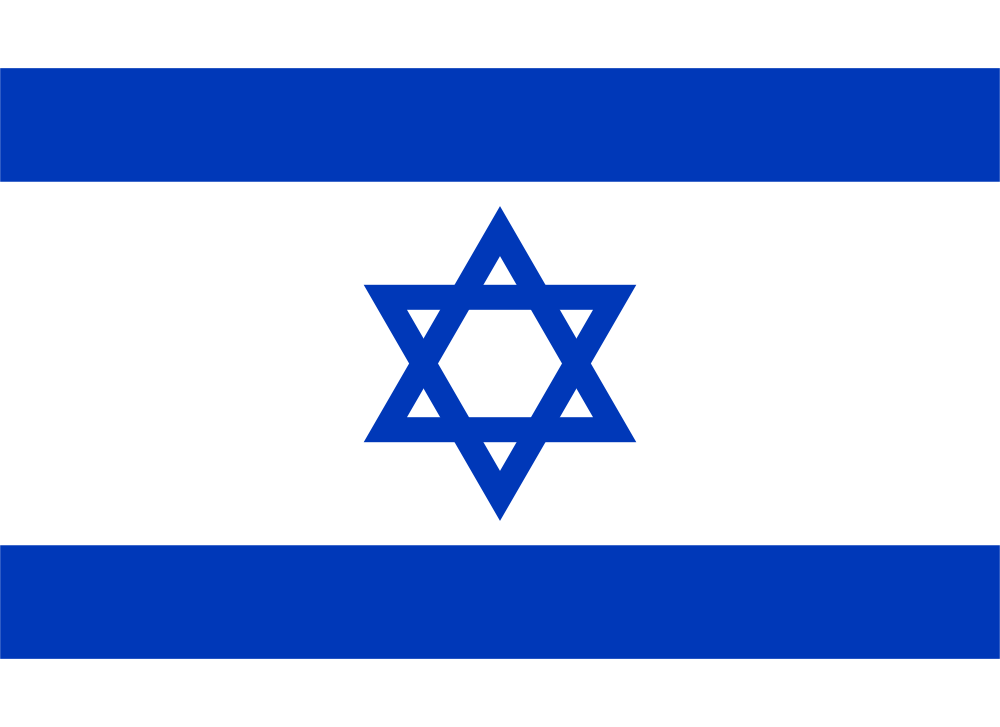
Israel🕣
State in the southwestern part of Asia. Official name – the State of Israel. Population – 8.8 million people (as of 2020). Capital – Jerusalem. Official language - Hebrew. Government type – parliamentary republic. Main religion – Judaism.
Israel
Greeting
Israel is a multicultural state where, alongside Jews, various ethnic groups reside, resulting in different forms of greeting. The traditional form of greeting in a business setting is a handshake, but among representatives of different ethno-cultural groups, it may vary.
The differences are particularly noticeable in greetings between people who are well-acquainted. For example, Arabs living in Israel often wrap their left hand around the other person's shoulder during a handshake and exchange kisses on each cheek.
A common greeting is "Shalom," which means "Peace," or "Peace be upon your house." "Shalom" is used not only when greeting but also when saying goodbye.
Physical contact between genders is not customary among Orthodox Jews, as well as among Arabs due to their Muslim traditions. Therefore, foreign women should wait for the man to initiate a handshake before extending their hand in greeting. The same applies to foreign men, who should pay attention to the woman's behavior in such situations.
At business events, participants may not introduce their wives who are present at the meeting, as this is not customary in traditional Arab families or among Orthodox Jews.
Introduction
In Israel, as in many other countries (especially Western ones), a person’s first name is placed before their last name. However, on official documents, for example, you may see the reverse order – the last name first, followed by the first name, often without a comma between them (as is customary in other countries). For instance, on a driver's license, a person named Aaron Cohen will have their last name listed first – Cohen, followed by their first name – Aaron.
This tradition sometimes leads to misunderstandings, as some last names resemble first names, such as Aaron Gideon. In such cases, ask your counterpart how they should be addressed.
In Arabic surnames in Israel, you often see the word "al," which in Arabic is the definite article and is not considered a separate word, such as in Ahmed Hassan al-Bakr. Also, the particle "abu," which means "father of somebody," is often found in Arabic surnames, for example, Abu al-Hasan, meaning "father of Hasan" – Abu al-Hasan al-Ash'ari. The prefixes "al" and "abu" should not be used separately without mentioning the rest of the surname.
Arabic surnames may consist of two parts, such as Mohammed Abdel-Jawad. You should not omit one of these parts and should give the surname in full.
Some Arabic or Jewish names have different spelling variants in other languages. For example, Ahmed and Ahmad are different ways to spell the same name in English. The same can be said for the names Hayim and Chaim. In such cases, it is important to ask in advance which spelling is correct for your counterpart.
When addressing counterparts in Israel (whether of Jewish or Arab origin), you should refer to their title, professional qualification, academic degree, or rank, if they have one. Otherwise, traditional forms of address, such as Mr., Mrs., or Miss, along with the person's last name, are appropriate.
It is important to emphasize the correct pronunciation of Arabic names and surnames, without omitting the mentioned prefixes and particles.
Exchange of Business Cards
Business card text should be in English on one side and in Hebrew on the other. Those with engraving are considered more prestigious.
Business cards are usually exchanged during the initial contact.
Foreign women who come to Israel should keep in mind that their partner might be an Orthodox Jew who may not be able to accept (for example, a business card) directly from a woman's hand. In this case, it is better to place the business card on the table in front of him.
Small Talk: Overview
Israel is a country where representatives of various national and ethnic cultures reside. Jews make up the majority of the population, but among the residents of this state, there is also a significant number (up to one-quarter of the total population) of non-Jewish citizens, predominantly Arabs.
Additionally, the Jewish population itself consists of people from different countries: former Soviet republics, European countries, North and South America, Asian and African countries. The style of conducting social conversations largely depends on the cultural traditions of the participants.
In Israeli society, emotional and expressive speech is common, often loud and accompanied by active gesticulation. Lively and rather lengthy discussions are typical, which in other cultures might be perceived as heated arguments.
Preferred Topics
During initial meetings, the focus is on topics related to the personal backgrounds of the speakers, such as origin, education, residence, etc. Additionally, topics related to family and (lastly) work may be touched upon. All of this helps to better understand the potential partner.
In subsequent meetings, polite questions about family are also welcomed, as they demonstrate the speakers' interest in each other.
Sports, especially soccer and basketball, are quite popular topics. Many Israelis love soccer and are eager to discuss the details of the latest game or debate who the best player is.
Travel is one of the favorite topics and is generally considered a safe subject.
Personal finances are considered an acceptable topic, and in Israel (unlike in many other countries), it is not considered taboo. This could include discussions about salary or the cost of certain services.
Taboo Topics
Strictly personal topics can be considered taboo. While showing interest in the family during a conversation is generally encouraged, detailed questions about family relationships or the health of specific family members should be avoided. Discussions about family matters should remain very general.
Politics, particularly the Arab-Israeli conflict and Israel's activities on the political stage, can be emotionally charged for many Israelis, as their families may have been involved in these processes.
National security issues: In Israel, citizen security is a top priority in domestic policy. Precautionary measures are encountered almost everywhere, such as in shopping centers, cinemas, airports, etc. During conversations with an Israeli partner, it's best to avoid discussing these measures, regardless of your opinion about them. The same applies to military service.
Avoid topics related to religion or the ethnic policies of the state. Israel positions itself as a Jewish state, but within it, there can be various tensions between Orthodox and secular Jews or between ethnic Israelis and immigrant communities.
Try not to engage in conversations about historical topics related to the relationships between Jews and non-Jews or between the state of Israel and the international community. Your partner in this country might find such topics sensitive.
Avoid any antagonistic statements.
Personal Space
The comfortable distance for communication in Israel is shorter than, for example, in Central and Northern European countries. People may stand quite close to each other during conversations. It's important not to try to increase this distance by, for example, stepping back, as this may be perceived as unfriendly behavior.
Israelis actively use body language during communication, which is generally quite lively. They engage emotionally in conversations, gesture frequently, and often speak very loudly.
Physical touch during communication is common in this society. It’s important to exercise restraint during conversations involving both men and women. For various reasons, it's advisable to avoid physical contact with people of the opposite sex—both men towards women and women towards men.
Gestures and gesticulation generally play a more significant role in the communication process than physical touch.
Communication Specifics
Israel is known for its extraordinary cultural diversity. In business situations, you may encounter people with various cultural backgrounds, religious beliefs, and educational levels. It's important to be careful with your speech and avoid any evaluative comments to prevent accidentally offending someone.
Israel is a relatively young country, with a significant portion of its population consisting of immigrants. As a result, communication preferences in society are based on clear and straightforward speech, with contextual factors like tone, emphasis, or the use of words in a specific sense (known to a small group) playing a lesser role.
Communication is predominantly explicit and verbal, with gestures and body language only supporting what is being said and do not carry any additional meaning.
Israelis prefer to express their thoughts directly and unambiguously, even when discussing someone's mistake or misstep. They generally value straightforwardness and honesty in communication.
When discussing a problem, your partner in Israel will not seek to obscure any aspect of it but will likely be ready to openly address its most painful elements. If you say something they believe is inaccurate, they will immediately point it out—there is nothing disrespectful in this.
Israelis enjoy debating, and sometimes it may seem like they are arguing for the sake of arguing. The exchange of arguments "for" or "against" an idea is an integral part of communication. This can be partly explained by ancient traditions in the field of learning and acquiring knowledge (it is known that the Talmud, a fundamental work of Jewish sages, is structured as statements, comments, arguments, and counterarguments regarding various laws or rules).
Any questions? Contact us.
Ask a Question