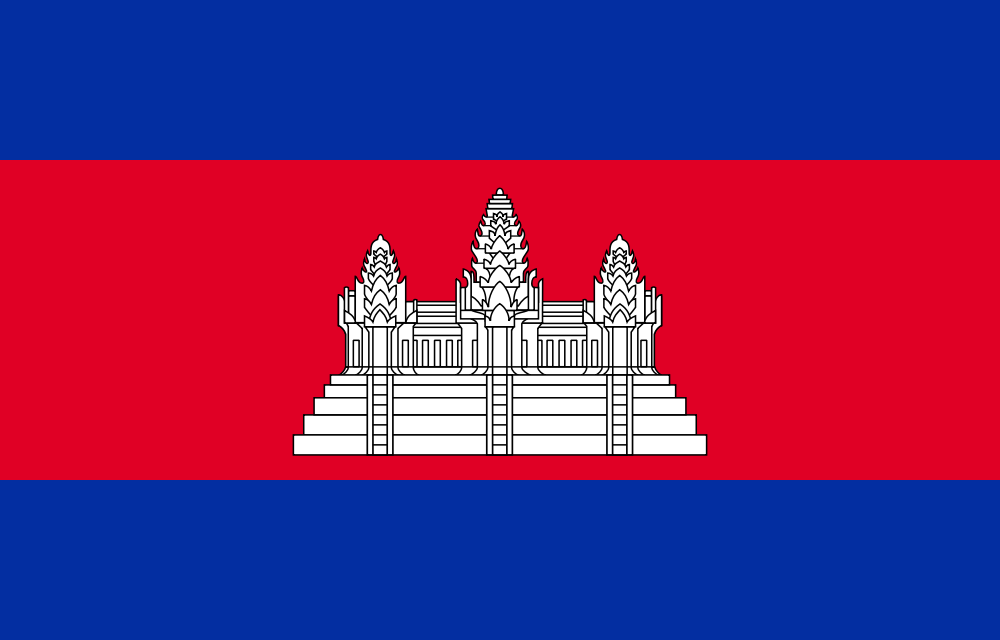
Cambodia🕣
State in the southern part of the Indochina Peninsula. Official name – the Kingdom of Cambodia. Population – 17.1 million (as of 2020). Capital – Phnom Penh. State language – Khmer. State structure - parliamentary constitutional monarchy. Main religion – Buddhism.
Cambodia
Greeting
There are different forms of greeting in Cambodia. In meetings with representatives of foreign companies and organizations, the accepted norm is a handshake, which should be gentle and short.
The handshake as a greeting ritual, however, does not apply to the women involved in the conversation. They are likely to be embarrassed if foreign men extend their hand to greet them.
The traditional greeting in Cambodia is som pa: the palms of the hands are placed together in a prayer gesture at chest or head level, but not above nose level. This gesture is accompanied by a slight bow towards the interlocutor.
In addition to the greeting itself, som pa often carries some additional meaning depending on the location of the hands and the depth of the bow. The higher the hands are raised and the deeper the bow, the more respect a person shows to his interlocutor. With the help of som pa Cambodians express feelings of gratitude and appreciation.
Women travelling to the country on business should remember that when greeting their Cambodian male partners are not ready to initiate a handshake, as it is not customary in their culture.
If you are not meeting with just one person but with a small group of Cambodian partners, start your greeting with the one who has the highest position or is the oldest. By doing so, you will show respect and at the same time knowledge of local rituals.
A person's status, primarily reflected in their position, title, or age, is a very important category in Cambodian business culture. For example, status determines the order in which people are greeted in a group or who should enter the meeting room first for a business talk.
Introduction
Many Cambodians still do not have surnames in the European tradition. Cambodians use their father's or mother's name or surname as their surname. As a result, siblings may have different surnames because they received their father's or mother's name as their surname.
Western naming practices are becoming more common and Cambodians are increasingly using surnames that are always placed before the first name, e.g.: Soth, Sopheap, where Soth is the surname, Sopheap is the family name.
This practice (surnames coming before first names) applies to both oral and written communication.
Women retain their maiden names after marriage, but it is not uncommon for women to add their husband's surname to their own. In recent years, women after marriage have increasingly begun to change their surnames to their husbands' surnames.
Exchange of Business Cards
The exchange of business cards in Cambodian business practice usually takes place after a verbal introduction of the partners during the first meeting.
In addition to the name, title, company name, and contact details, it is common to include the holder's educational degree, scientific title, and professional qualifications, if any.
It is advisable to prepare business cards in advance with text in two languages, e.g. English and Khmer. In this way, you will show respect to your colleagues from this country and at the same time avoid misunderstandings that often arise when specifying, for example, the person’s position.
Business cards should be handed to your partner with your right hand or with both hands. The text in Khmer should be on the front side. When you receive a business card, also hold it for a while with both hands, look carefully at the text, and then put it on the table or in your business card holder in front of you.
Small Talk: Overview
Your Cambodian partners will appreciate it if you say a few words in their language. Even if you make mistakes or say something that is not quite right, it will still be well received.
Cambodians make very limited use of body language during conversation and are somewhat suspicious of those who gesticulate excessively. Showing emotion during communication is not common.
Refrain from showing negative emotions during communication. Anger, irritation - all of these can lead to a loss of face of the people present, which can affect their relationship.
Cambodians traditionally keep the conversation in a soft, at first a little reserved, but always friendly manner.
In the course of communication Cambodians often smile, believing that a smile gives communication a special warmth. A reciprocal smile on your part will be appreciated.
If you are sitting at a low table or on the floor during an event, pay attention to your posture. Your partner should not see the soles of your shoes; this is considered a very rude gesture, even an offense, as feet are considered a dirty part of the body.
Preferred Topics
Family, city, country you come from. Cambodians are happy to converse about these topics while sharing similar knowledge about themselves.
Work and topics related to professional life.
Taboo Topics
Any negative (even in a veiled form) remarks about other people always lead to the loss of "face" of the interlocutors, and thus to a breakdown of harmony in the conversation.
Do not confuse Cambodians with Thais, Vietnamese, or other Southeast Asian cultures. Each has a rich history and its own specificity.
Never say anything disrespectful about Buddhist temples, monuments, or monasteries. Buddhism in Cambodia has the status of the state religion, which is practiced by about 93% of the country's population.
One of the most acute topics in Cambodia is still the Khmer Rouge regime that existed in the country in the last 20-25 years of the previous century. A particularly painful topic is the genocide that killed up to 3 million people.
Many people in Cambodia still vividly remember and relive the events that took place during the Khmer Rouge rule. Even if your interlocutor brings up this topic, refrain from making any comments. In such situations, it is better to just listen.
Politics, especially domestic and regional politics, and religion are taboo topics.
Personal Space
The distance of comfortable communication in Cambodia is an arm's length. In communication between friends, this distance is usually shorter.
If the participants in a conversation are a superior and a subordinate, the distance between them will increase, it will be greater than arm's length. On the contrary, friends or close acquaintances stand closer to each other.
Physical contact and any touching, except a handshake, is minimal in Cambodian communication culture.
When communicating, Cambodians maintain indirect eye contact: they look away or look down, only occasionally crossing their gaze with the other person. It is not customary in this society to stare at each other during a conversation.
Communication Specifics
An important concept in Cambodian culture is "face" and the related concepts of "losing face" and "keeping face". It refers to a person's reputation, appearance, and image. Loss of face occurs when a person is criticized, objected to, or humiliated in the presence of others.
For Cambodians, saving their face and preventing others from losing face is a very important element of communication. They can make great efforts to avoid conflict if possible. In this case, they prefer to speak very cautiously, not calling things by their names, trying to keep things formal, and generally speaking "around" the topic rather than about it.
When communicating with Cambodian partners, it is important to pay attention to various verbal and non-verbal signals. One such signal is the word "Yes", which in other cultures is an indication of an affirmative response, for example, in response to a request or question. To your Cambodian colleague, "Yes" is more likely to mean "I understand" or "I am listening" than "I agree" or "I will do". For reasons of loss of face, he will refrain from giving a direct negative answer.
When building business relations with Cambodian partners, it is important to always keep in mind the peculiarities of their communication (first of all, the concept of face). In sensitive situations, it is better to return to the topic under various pretexts and ask the question you are interested in several times, but as if from a different perspective.
Modesty and humility are important qualities in Cambodian culture. In this regard, compliments and praise will most likely be silently unsupported by your interlocutor. Equally, any form of self-promotion and boasting is not accepted.
Any questions? Contact us.
Ask a Question